·
May 26, 2025
You Are Not Your Mind - The Power of Moving Meditation as a Powerful Ally
Awareness is The Stillness of Being
Stillness is our natural state. Beneath all that mental noise, concerns and pressing thoughts lies the essence of presence. The stillness of being can be harnessed through mindfulness meditation, a practice rooted not in stopping the mind but rather in focusing our attention. It encourages us to observe our thoughts in the present moment without control or judgement, simply as the silent watcher of the mind. Paired with moving meditation and the ancient wisdom of samurai philosophy, meditation becomes a powerful ally on the path of mastering the mind.
This article delves deeper into exploring the practice of sword-based moving meditation, the distinction between ourselves and our minds, Eastern philosophy versus Western science, and how meditation guides us toward the mastery of thought.
Sword-Based Moving Meditation: Zen Philosophy and Samurai Focus
Although swords and meditation may seem worlds apart, upon close examination, they have more in common than one could ever imagine. The use of swords in meditation has a long history that spans different cultures and traditions.
This ancient form of sword-based meditation is a powerful example of moving mindfulness, rooted in both Eastern spiritual practice and physical mastery.
The foundation of this practice is moving meditation, a combination of two fundamental aspects: intentional physical movement and focused awareness. It means becoming consciously aware of every element required for even a single motion: the coordination of muscles, the signals from the brain, the alignment of breath, and the presence of the mind. It’s the art of paying full attention to how the body moves, and the harmony that aligns internally to make that movement possible. Through this awareness, the sword becomes not just an object, but an extension of presence itself.
When it comes to sword-based meditation, the sword is far more than a weapon; it is a spiritual, psychological and symbolic tool. This practice involves wielding and drawing the sword, often described as ‘Zen in Motion’, in which one defeats the opponent who is oneself. These movements require precision, concentration and the utmost mind-body control. Another way the sword reflects meditation is that the tip symbolises pure focus, just as its energy is concentrated at its sharpest point. Meditators learn to focus their attention on a single point of awareness (Phal, 2025).
The sword is used as an anchor for attention and awareness, serving as the mirror or projection of one’s own mind; a shaky mind means a shaky sword. The blade represents the clarity and sharpness of the mind; it can enable clear thinking by “cutting” through illusion, ego and overthinking, leaving only one’s truth unveiled. Just as the sword cuts through wood with precision, meditation helps us to “cut” ourselves from the dualities we have unconsciously perceived from the outside world. The trivial from the crucial, the truth from fallacy, the good from the bad. True Balance doesn’t exist at either end of this mental polarity, but rather in the centre, where even in movement, we can keep still.
The Self vs the Mind
It is often believed that we are our mind; who else could we be, right? Other than our thoughts? Our emotions? The voice in our head speaks loudly and judges our actions, reactions, thoughts, feelings and words; but people don’t know that the quirky voice drilling through our brain is not ours, but rather our ego. Ego refers to a false self created by an unconscious identification with the mind, and to the ego, the present moment is irrelevant; only the past and future are important. This is why being identified with the mind is being trapped in time (Tolle, 1997).
This is especially relevant during mindfulness meditation because only through watching our emotions in the present can they be brought into awareness. The self and the mind can be separated as follows: the mind, which is constantly rushing, overthinking, and planning; and the self, which can act as the silent witness beneath it all. Understanding the distinction between the ego and the true self is essential in mindfulness practice and present-moment awareness.
It is simpler to think of it as two people, and the key is to have a healthy relationship between them. In this way, we can become the masters of our minds and not the other way around, knowing that we are two identities or rather that we have a false one, we don’t have to believe every thought that stumbles its way through our minds. By establishing this space between us and our thoughts, we can decide what comes in, what doesn’t, and simply observe.
How Mindfulness and Meditation Rewire the Brain
Our mind is a thinking machine; there is no way not to think or be in a blank state of mind. When people start meditating, they are often surprised by the number and variety of thoughts that constantly roam through their minds. This realisation can be seen as a personal milestone, given that it is the first time people notice they can witness their own thoughts, call it awareness, beingness or consciousness.
Every meditation experience is different for everyone, and it can be really frustrating at the beginning. But with patience and constant mindfulness training, the period of silence between our thoughts increases, and eventually one can stay in this state of awareness, in this “gap,” even after the meditation period.
Meditation is rooted in our breath, inhale and exhale. It is the core, the anchor, the mediator. While we observe our thoughts without judging them, the breath brings us back from drifting and keeps the meditation afloat.
Mental and Physical Benefits of Meditation According to Neuroscience
Meditation offers profound rewards, both mentally and physically. While Eastern traditions have long taught that awareness brings clarity, balance, and healing, Western science is only beginning to uncover how deeply the brain responds to stillness.
Research published in PubMed and Harvard has shown that meditation significantly reduces stress levels. Stress is a contributor to impaired immune response, metabolic dysfunction, autoimmune disorders and even cancer. Many of these illnesses, as Eastern medicine has long suggested, come from unresolved emotions trapped in the body as sensations.
The amygdala is a small but powerful structure within the brain’s limbic system. It plays a crucial role in processing emotions, particularly fear and threat detection. reacting instantly to our experiences, and when faced with stressful situations, it can trigger a fight-or-flight response. When we experience stress, the amygdala activates, often without our conscious awareness.
The amygdala has the ability to grow and shrink, and the more active and enlarged it becomes, the more reactive we are (Calm, 2024). Studies have shown that meditation can reduce amygdala size (Harvard Gazette, 2018), leading to calmer responses and greater emotional resilience. Meditation gives us the ability to choose our response rather than abruptly react and then regret our actions.
The image below shows Functional MRI (left) showing amygdala activation when participants watched emotionally charged images before meditation. After eight weeks of training in mindful attention meditation (right) the amygdala is less activated.
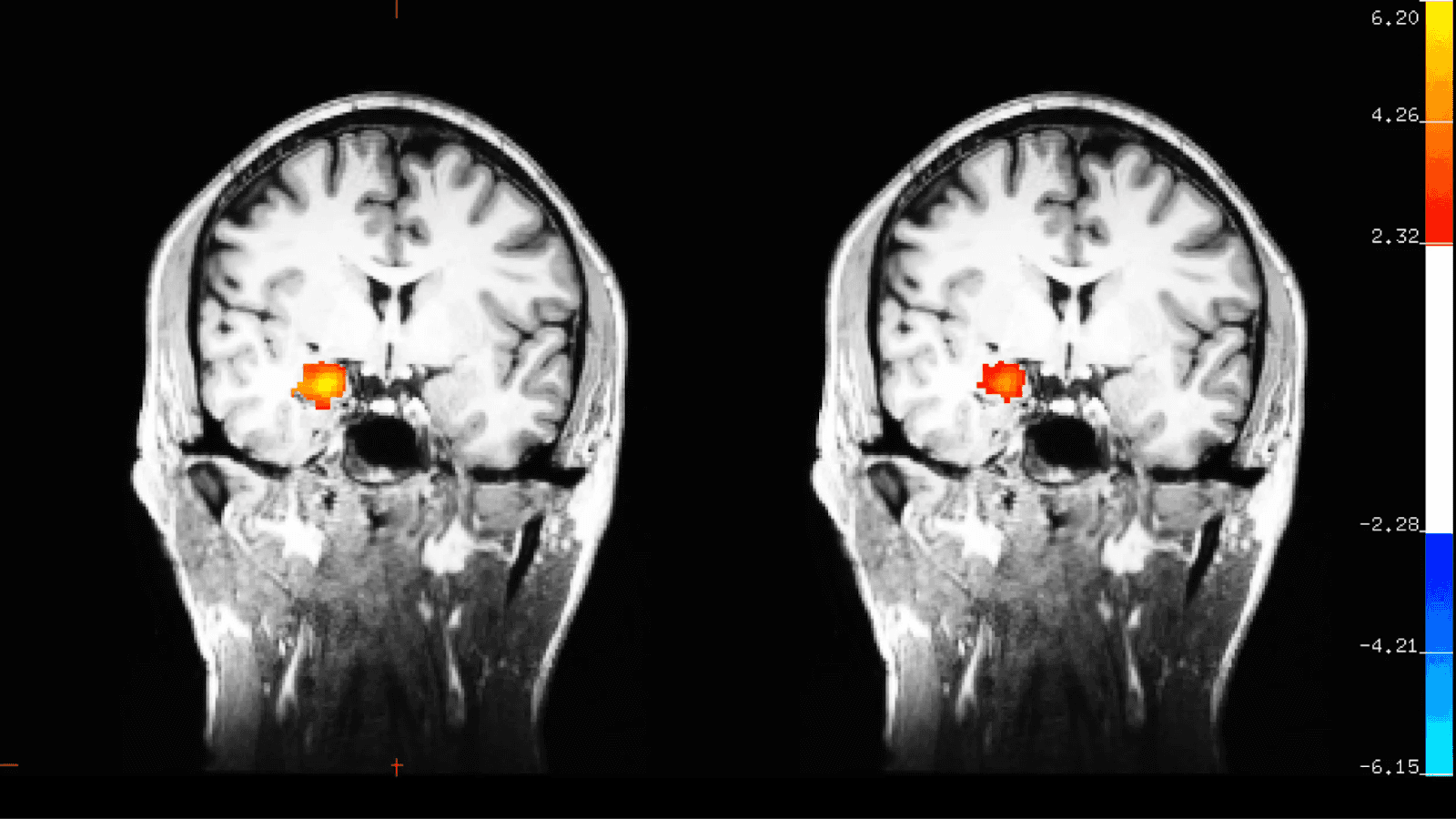
Image Source: Desbordes, G. (2018). “Harvard researchers study how mindfulness may change the brain in depressed patients.” Harvard Gazette.
During mindful or moving meditation, brain regions such as the cingulate cortex, which is involved in attention and habit formation, automatically change. As neuroscientist Nazareth Castellanos notes, the cingulate helps “make the unconscious conscious,” allowing us to catch ourselves when we wander and return to the present (Castellanos, 2025). With meditation, this region becomes more flexible, meaning we come back to awareness faster, and we come back to ourselves.
Unlike other skills, Meditation not only trains specific brain areas but it rather serves as a communication enhancer between regions like the prefrontal cortex, limbic system and sensory areas (Calderone et al.). Modern brain imaging confirms what eastern philosophers have known for centuries: awareness transforms the brain, and through consistent practice, we are no longer at the mercy of reaction, but anchored in presence.
Returning to the Self Through Awareness
Ultimately, meditation, whether still or in motion, is not about controlling the mind, but about changing our relationship with it. The mind will continue to think, analyse and plan; that is its nature. Through awareness, however, we begin to understand that we are not confined to those thoughts, but rather the space in which they arise.
Practices such as moving meditation remind us that presence does not require immobility. Stillness can exist within action, just as clarity can exist within complexity. Through breath, movement and focused attention, meditation gently guides us back to the self that exists beneath mental noise; calm, observant and rooted in the present.
By recognising the difference between the self and the mind, we soften our identification with thought and create space for conscious observation. We no longer need to follow every mental impulse, but can simply witness it as it comes and goes. In turn meditation becomes not an escape from life, but a quiet return to it, a way of meeting experience with balance, awareness and stillness.
References:
admin. “Meditation as Medicine - Dandenong Neurology.” Dandenong Neurology, 21 May 2018, dandenongneurology.com.au/meditation-as-medicine/.
Battle-Merchant Medieval Shop. “Swords in Meditation: Focus and Symbolism.” Battle-Merchant ⚔, 9 Jan. 2025, www.battlemerchant.com/en/blog/swords-in-meditation-focus-and-symbolism. Accessed 26 June 2025.
Calderone, Andrea, et al. “Neurobiological Changes Induced by Mindfulness and Meditation: A Systematic Review.” Biomedicines, vol. 12, no. 11, 15 Nov. 2024, pp. 2613–2613, https://doi.org/10.3390/biomedicines12112613.
calm . “The Benefits of Moving Meditation and How to Start Practicing.” Calm Blog, 18 Dec. 2024, www.calm.com/blog/moving-meditation.
---. “The Neuroscience of Meditation.” Calm Blog, 27 Oct. 2024, www.calm.com/blog/the-neuroscience-of-meditation.
Castellanos, Nazareth. “Nazareth Castellanos – Cursos de Neurociencia.” Nazarethcastellanos.com, 2023, nazarethcastellanos.com/. Accessed 3 July 2025.
Kabat-Zinn, Jon. “Mindfulness Definition.” Greater Good, 2019, greatergood.berkeley.edu/topic/mindfulness/definition.
Meditate, Wee. “What Is Moving Meditation? Plus, How Kids Can Easily Practice - Wee Meditate.” Wee Meditate, 31 May 2024, www.weemeditate.com/what-is-moving-meditation/. Accessed 25 June 2025.
Mineo, Liz. “Less Stress, Clearer Thoughts with Mindfulness Meditation.” Harvard Gazette, 17 Apr. 2018, news.harvard.edu/gazette/story/2018/04/less-stress-clearer-thoughts-with-mindfulness-meditation/.
Morrow, M. (2023, October 25). Eckhart Tolle’s critical take on ego and finding peace. Medium. https://medium.com/change-your-mind/eckhart-tolles-critical-take-on-ego-and-finding-peace-19cd2f399168
Powell, Alvin. “Harvard Researchers Study How Mindfulness May Change the Brain in Depressed Patients.” Harvard Gazette, Harvard University, 9 Apr. 2018, news.harvard.edu/gazette/story/2018/04/harvard-researchers-study-how-mindfulness-may-change-the-brain-in-depressed-patients/ .